By Annie Hill
The original article in Russell Lights | Ngā Mārama o Kororāreka, October 2026 edition
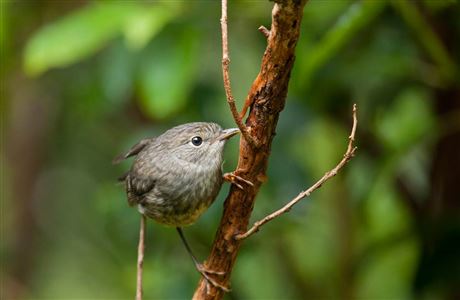
The Toutouwai North Island Robin, Petroica longipes is endemic to the North Island of New Zealand. (The Kakaruai South Island Robin, has two subspecies: Petroica australis australis, and P. australis rakiura.) They’re closely related to Miromiro Tomtit, and the black Robin of the Chatham Islands. This article is just about the Toutouwai, but the Robins all have similar ecologies.
I suspect that its erect stance on long, skinny legs, combined with its confiding nature, are responsible for its name, because the birds are very reminiscent of the friendly British Robin.

They often approach close to people sitting down; I’ve even had one sit on my boot. Their bold and curious nature, combined with the fact that they’re always motivated for food, makes them ideal for testing behavioural and cognitive tasks. They apparently have excellent spatial and long-term memory and numerical competency, which help their success in the wild.
Robins are largely grey. Males for the first 2 or 3 years, become darker each time they moult, although some never darken. Females are light to dark grey, and both sexes have a pale grey-white patch on their breast. Juveniles look similar to females. The patch is smaller than on South Island Robins and never has any yellow shading. (This difference in colouration is intriguing: South Island Tomtits have yellow patches and Mohua have yellow heads in the south, and white in the north. Why do South Island birds have yellow colouring, I wonder?) Pale shafts on their feathers create a faintly streaked appearance, while a hidden patch of white feathers by the beak, is occasionally “flashed” at other birds. Robins are 10 to18 cm long and weigh around 35 g, with males being slightly larger.
Toutouwai are great songsters: their way of proclaiming territories and attracting mates; bachelors spend much more time singing than paired males. The male generally sings his loud song all year round, most often in the non-breeding season. Sometimes he sings for half an hour, showing that he’s well-fed and very good at finding food, and thus a more desirable mate. Singing requires a lot of energy. Both sexes sing a quieter version, most frequently during their moult. They also give a single ‘chuck’, as a contact call, or several loud ones in rapid succession as an alarm call.

Robins’ natural habitat is in native forest, but they can also be found in tall scrub and mature, exotic plantations, with a moist understorey. Nowadays, populations are mostly in central North Island, the Bay of Islands, Little Barrier Island and Kapiti Island. They’ve been reintroduced in the Zealandia sanctuary; at Bushy Park near Whanganui; on the Coromandel Peninsula and of course with Project Island Song. Translocations on other islands and on mainland sites with good pest control, have supported the population to an estimated 10,000 birds.
Toutouwai males fiercely guard their territory all year, inhabiting the same 1 to 5 ha patch (often smaller on pest-free islands) of forest throughout their life. Pairs start nesting in September, with the female building an open-cup nest, while the male brings food 2 or 3 times an hour. Nests are built against tree trunks: in forks, where branches join, or on epiphytes next to trunks. The birds are monogamous, although occasionally females change mates and may go away after successfully fledging a brood, leaving the male to rear the fledglings. It can also happen after eggs or nestlings have been predated, although generally, she’ll lay a replacement clutch within a few days. She lays two or three eggs, incubating them alone for18 days. Her mate calls her from the nest every 20 minutes or so, to provide her with food, but soon after the eggs are hatched, he takes all the food to the brood. Nestlings leave after about 3 weeks and continue to be fed by their parents for a further 5 or 6 weeks. If there’s only one fledgling, the male feeds it, while the female builds another nest and incubates the next clutch. With two fledglings, the pair feeds a chick each and with three, the male usually looks after two, and the female one. When the fledglings are independent, the pair may breed again. Juveniles become sexually mature between six and 12 months of age, and Toutouwai can live for at least 15 years in the wild.
Robins spend a lot of time on the ground searching for food, making them very vulnerable to stoats and cats. They also forage over trunks and branches, especially those covered in mosses. They spot prey from a perch, or by actively searching the ground or trees, using foot trembling, wing-flicking and tail-flicking, to flush out cicadas, earthworms, wētā, snails, spiders, slugs, etc. Slugs are wiped on the ground, presumably to get rid of slime, before they’re eaten. If a bird catches something very large, or has already eaten sufficient, it often kills and caches it, retrieving the food over the next couple of days. A male was observed emptying five consecutive caches, before taking them to his mate, sitting on her eggs. They can tell their caches apart and prioritise them by size, counting up to 12 items, apparently the highest recorded number any animal can count.
Pairs remain in their territories, sometimes going elsewhere to drink and bathe, or sneaking into those of neighbouring birds to feed. Because males dominate their mates out of breeding season, pairs are rarely found together. Their slightly different foraging methods tend to reduce competition, but both will steal food from the other’s cache, and are less likely to cache, if their mate is present. This means that females avoid males when foraging, but fortunately for her, males tend to cache more often.
Robins also eat small ripe fruit, particularly during dry periods, when soil-dwelling invertebrates are unavailable. Their high metabolic rate mean that they might spend as much as 90% of winter days, finding and storing food.

During the 19th and 20th centuries, forest clearance destroyed much Toutouwai habitat, but today predation by introduced predators, such as stoats, possums, and ship rats is their main threat. Without predator control, eggs, nestlings and adult females are frequent victims, leading to an excess of male birds, but where pests are virtually eradicated, populations increase rapidly. While, they’re rarely found in suburban areas, due to the prevalence of cats, a visit to Urupukapuka or Moturua will probably reward you with several sightings of these delightful little birds.