
By Annie Hill
The original article in Russell Lights | Ngā Mārama o Kororāreka, September 2026 edition
One of the tasks I’ve been asked to undertake for Russell Landcare, on volunteer Wednesday mornings, is the cleaning and sterilising of plant pots. Now, nobody would ever suggest that my mantra is ‘Cleanliness is next to Godliness’, and I couldn’t help feeling that all this fuss was a little over the top. When I asked why it was necessary to be so careful, I was told ‘Argentine Ants’. I remembered that when I was staying with a friend in Nelson, she mentioned that the local council had told her she had an infestation of these insects and please would she deal with them – at her own expense. These ants are obviously unpopular, but living on a boat, I have relatively little contact with insects and am far more ignorant about them than I should be. This seemed a good reason to start learning a little more.

I was somewhat surprised to discover that ants are in the same order as wasps – Hymenoptera – and evolved from them. There are estimated to be around 22,000 different species of ants and their colonies can range from a dozen individuals to hundreds of millions. In total, their biomass may exceed the combined biomass of wild birds and mammals. (While this statistic is impressive, it’s worth bearing in mind that humans and their domestic mammals, make up 96% of the biomass of mammals, and our fowl 71% of avian biomass!) It’s hard to believe that one species out of 22,000 could be such a danger to our motu, but the Argentine Ant, Linepithema humile, is well into the top 100 of most invasive species.

As the name implies, these insects originate in Argentina and neighbouring countries, where they live along the floodplains of the Paraná river. They thrive in a Mediterranean climate and have now spread to every continent on earth, apart from Antarctica. Indeed, they’re as widespread and successful as human beings, who are undoubtedly responsible for their dispersion, probably by way of ships.
In their native range, Argentine Ants behave similarly to any other ant, living in colonies and defending their territory against all other ants, regardless of species. However, as they’ve dispersed, they no longer compete with one another, but form supercolonies, which consolidate their invasive success. Scientists have studied these in detail and found that their genetic makeup is so uniform, that individuals from one nest can mingle in a neighbouring nest without being attacked. Several subsequent studies used genetic, behavioural, and chemical analyses, which show that introduced supercolonies on separate continents actually represent a single global supercolony. And supercolony is no exaggeration – the largest one recorded stretches over 6,000 km along the Mediterranean coast! It was estimated in 2010, that the Very Large Colony, which covers territory from San Diego to beyond San Francisco, might have consisted of one trillion individuals. However, it would appear that some supercolonies can differentiate between their own and alien ants: in a piece of rather grisly research, two adjacent (and one assumes, ever-expanding) supercolonies, are clashing near San Diego. On the border between them, thirty million ants die each year, on a front which covers many kilometres. While the battles of other ant species generally constitute colony raids lasting a few hours, or skirmishes that occur periodically for a few weeks, Argentine Ants clash ceaselessly; the borders of their territory are a site of constant violence, and conflicts can be fought on top of hundreds of dead ants.
Argentine Ants often displace most or all native ants. They may prey on native invertebrates and even small vertebrates, unaccustomed to defending themselves against aggressive ants. This can result in harm to other species in the ecosystem, such as plants, dependent on particular ants for seed dispersal, or lizards which also feed on ants and invertebrates. For example, in South Africa, the Ant has occasionally crowded out native ants which disperse the seeds of Fynbos plants. They leave the seeds on the surface, rather than taking them underground like the natives, so the seeds don’t germinate.

As with other species, Argentine Ants farm other insects, including pest species such as aphid, mealy-bug, and scale insect colonies, for their honeydew, which the Ants eat. They even relocate the parasites to unaffected plants, causing problems to agriculture, by protecting these insects from predators and parasitoids. Their rapacious behaviour also adds pressure to Bumblebee populations, competing for the same resources. While the bees can fight back, when bitten by ants, this takes time and energy, which could be better spent foraging and thus pollinating plants. By predating on their larvae the Ants may also decrease the number of pollinators visiting flowering plants.
In this country, Argentine Ants kill and displace native invertebrates, eating lizards, birds’ eggs and newly hatched chicks. During spring and summer, when nests are expanding, they have an insatiable appetite for protein and sweet foods such as honeydew and nectar, competing with Kiwi, nectar-eating birds, skinks and geckos, and native invertebrates for food sources.
For such a fearsome predator, an Argentine Ant is an unimpressive insect, 2 to 3 mm long, and usually a honey-brown colour (while most other ants here, are black). It is their sheer number that makes them formidable, but their success story is rooted in their adaptability to various climates and environments. They thrive in both natural ecosystems and urban landscapes, where they feed off food waste, and shelter in man-made structures, which further aids their dispersal.

Another advantage they have over most ants, is a high proportion of queens to workers. While quiescent during the colder months, queens produce eggs in late-winter, nearly all of which hatch into sexual forms by late spring, when the females emerge and mate. About 50% of the workers in the colony dies off over winter, so the high proportion of queens significantly helps the numbers to bounce back.
Controlling Argentine Ants has, obviously, been less than successful to date. Best results come from exploiting their omnivorous dietary habits, through the use of slow-acting poison bait, like fipronil, which will be carried back to the nest by the workers, eventually killing all individuals, including the queens.
According to DOC, the highest risk for spreading Argentine Ants is in potted plants. I now completely understand why they are a dire threat, and why we have to clean and sterilise our re-cycled pots, before planting seeds and cuttings in the new nursery.
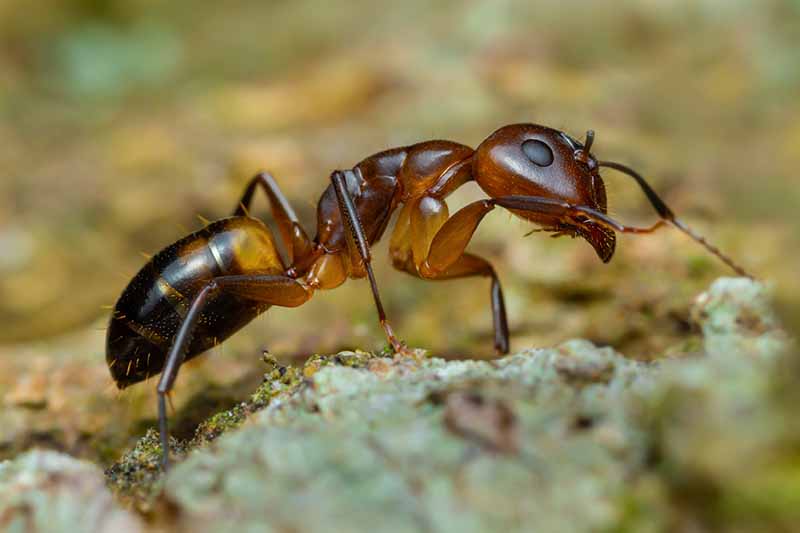
Pōpokoriki | Argentine Ants | Linepithema humile
📸 Gardner’s Path